Why drill and blast is where open-cut mining efficiency begins - and where it is most often under-reported
Drill and blast is the first transformation in the open-cut mining value chain. Every shovel cycle time, every truck load factor, every crusher feed rate and every SAG mill throughput figure downstream is partly a function of the fragmentation quality produced in the last blast. Yet in many operations the performance feedback on blast design is limited to a post-blast visual assessment and a dig-rate observation that is rarely linked back to the specific blast design that produced it.
Systematic drill and blast reporting closes this feedback loop. It tracks drill productivity, blast design compliance, fragmentation outcomes and downstream effects in one place - so the blast engineer can see whether a design change that increased powder factor actually improved dig rate and crusher throughput as intended, or whether it produced finer fragmentation in one area at the cost of oversize and increased secondary breaking in another.
The metrics that belong on a drill and blast performance dashboard
- Drill productivity (m/hr and m/shift) - by drill rig, rock type and hole diameter; the primary drill fleet efficiency metric
- Blast design compliance - burden, spacing and sub-drill vs design plan; the connection between design intent and execution
- Powder factor (kg/tonne and kg/BCM) - actual explosive consumption per tonne and per BCM; compared to design and benchmarked by rock type
- Fragmentation P80 (mm) - the size at which 80% of the broken rock passes; from image analysis or laser sizing
- Oversize percentage (%) - proportion of material above crusher feed size; drives secondary breaking cost and throughput bottlenecks
- Dig rate (BCM/hr) - excavator productivity post-blast; the most sensitive and direct downstream measure of fragmentation quality
- Misfires and blast incidents - safety and regulatory reporting on blast events
Rock type and domain: why one powder factor does not fit all
Open-cut mines typically encounter multiple rock types and geological domains with different hardness, fracture density and blastability characteristics. A powder factor that produces optimal fragmentation in soft, highly fractured mineralised ore may produce unacceptably coarse fragmentation in harder, competent waste rock - or over-crush softer material to produce fines that increase mill load without improving throughput. Drill and blast reporting that breaks design compliance and fragmentation outcomes down by geological domain and rock type allows the blast engineer to calibrate powder factor and design parameters to the specific blasting characteristics of each zone.
Connecting blast outcomes to downstream efficiency: the full value chain view
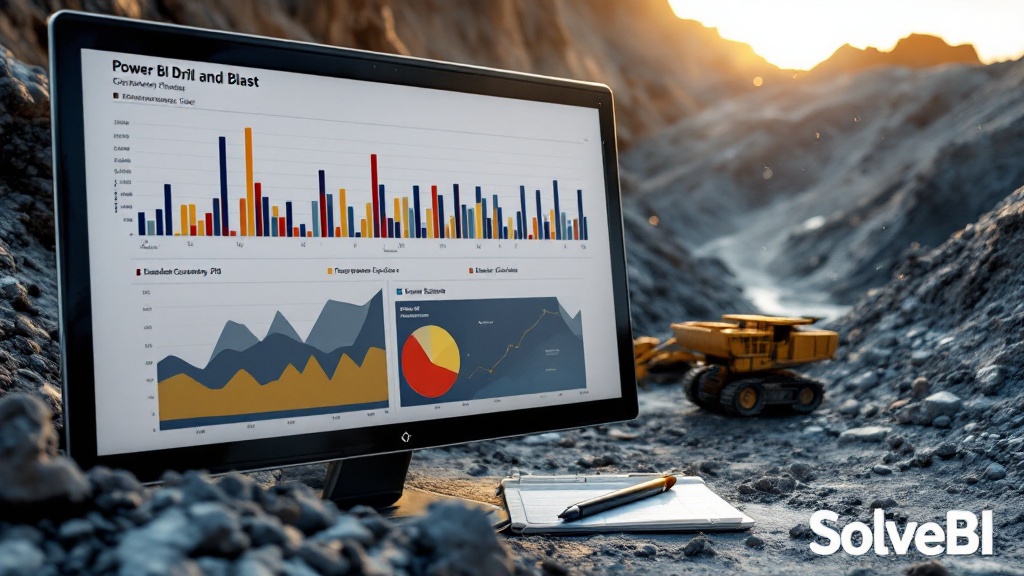
The full case for drill and blast reporting is made when blast design parameters are connected to downstream outcomes in the same dataset. When the blast engineer can see that a 10% increase in powder factor in the north pit produced a 15% reduction in P80 and a 12% improvement in excavator dig rate - but the same design change in the south pit produced minimal fragmentation improvement at 15% higher explosive cost - they have the data needed to make confident blast design decisions rather than engineering judgement calls.
Blast report log vs a systematic drill and blast dashboard
Blast report log vs unified drill and blast dashboard
| Aspect | Blast report log | Drill and blast dashboard |
|---|---|---|
| Design compliance visibility | Summarised in post-blast report; rarely trended | Continuous - burden, spacing and powder factor vs plan on every blast |
| Fragmentation linked to design | Separate records; linked manually if at all | P80 and oversize joined to the blast that produced them |
| Downstream connection (dig rate) | Known qualitatively by excavator operators; not quantified | Excavator dig rate from dispatch linked to each muck pile blast |
| Rock type breakdown | Single site-wide average | Per geological domain and rock type |
| Trend and optimisation analysis | Retrospective; done in annual review | Continuous - design changes visible in outcome data within the period |
The Power BI and Fabric architecture behind drill and blast reporting
On a typical SolveBI deployment we integrate blast management system exports (Orica ShotPlus, Dyno Nobel ARES, DetNet), drill monitoring system data, fragmentation image analysis results (Split Engineering, Wipfrag), dispatch dig-rate records and crusher feed data into Microsoft Fabric, then build a drill and blast performance model in Power BI. The blast engineer sees design compliance and fragmentation by domain; the drill supervisor sees drill productivity; the mine planner sees the downstream efficiency impact of blast design choices - all from one consistent dataset.
Common mistakes in drill and blast performance reporting
- Reporting blast events without fragmentation outcomes. Knowing that a blast was fired to design plan says nothing about what it produced downstream.
- No dig-rate linkage. Dig rate is the most sensitive and immediately available measure of blast quality - but it requires the dispatch and blast records to be joined.
- Site-wide powder factor averages. Averaging powder factor across rock types obscures the domain-specific calibration that blast optimisation requires.
- Fragmentation measured visually only. Visual assessments are useful but subjective and not reproducible. Image analysis or laser sizing produces a defensible, quantitative P80.
- No feedback loop from downstream to blast design. If the blast engineer never sees the crusher feed size, mill throughput or dig rate data from their blasts, there is no systematic learning from outcomes.
From a post-blast visual assessment to a systematic feedback loop connecting blast design to downstream efficiency.
Book a free 30-minute consultation with a SolveBI consultant. We'll map your blast management, fragmentation and dispatch data, and design a drill and blast dashboard that closes the loop from explosive design to mill throughput.